Touch-Sensor LED Mirrors: Prices and Features Compared

Artessa's GlowZen, Oblio and Avelis all describe touch-operated features, yet they offer different shapes and product details. A touch sensor is an interface, not a complete specification. It tells you how you interact with the mirror, but it does not by itself establish whether you can dim the light, change its colour or control a defogger separately.
The useful way to compare touch-sensor LED mirrors is to connect each function to your routine, then check the price of the exact size and configuration. Paying more for a larger mirror may be sensible. Paying more because several unrelated functions have been compressed into the word “smart” is harder to assess.
Separate the sensor from the functions behind it
Touch control replaces a mechanical switch on the mirror with a responsive area of the surface. Depending on the design, a tap or longer touch may produce different actions. The number of symbols and their placement can also vary, so two touch mirrors may feel quite different to operate.
Begin with the functions you actually need. Switching the light on is one function. Changing light colour is another. Adjusting brightness is a third. Defogging and memory are additional behaviours that should each be confirmed. A photograph of one glowing button cannot reliably tell you which of these are available.
Ask for the operating sequence before you buy. If one control cycles through several settings, consider whether that suits you. If you prefer direct access to a single function, establish whether separate controls are provided. Clear operation can matter more than a long feature list, particularly in a bathroom used by several people.
Use current prices as reference points
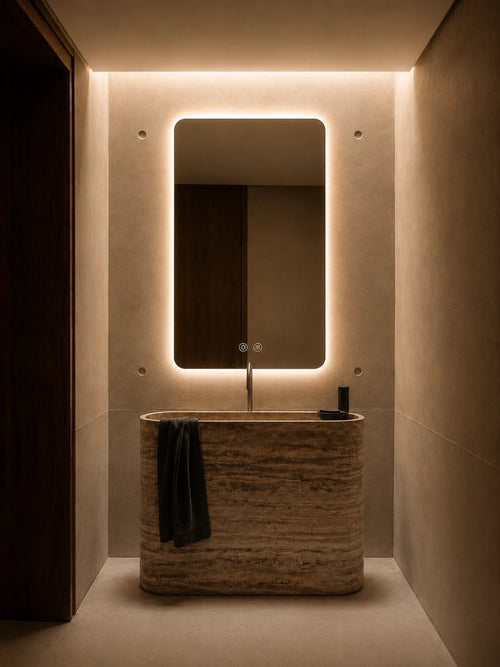
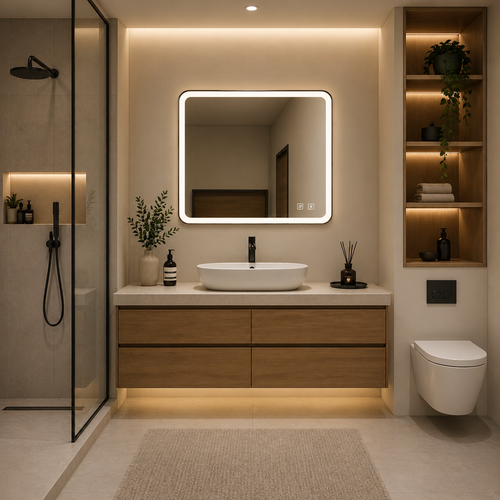
GlowZen lists 45 × 60 cm variants at ₹4,999 and 50 × 70 cm variants at ₹6,999, checked on 7 September 2026. Its description identifies three light temperatures and touch dimming. Horizontal and vertical options appear in the listing; confirm the installed height and width of the version you select.
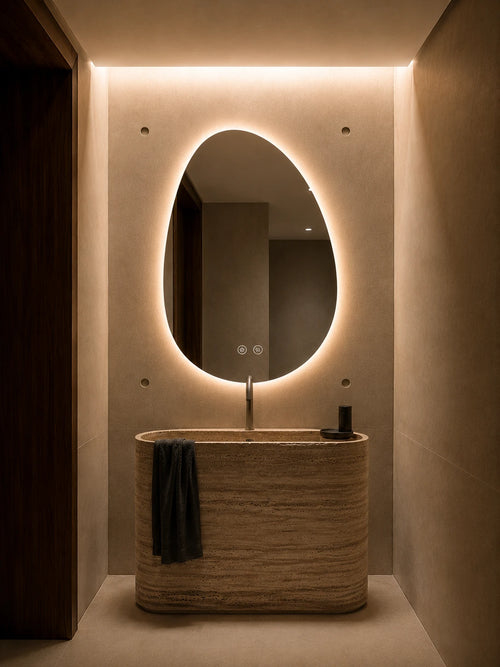
Avelis lists its 60H × 45W cm variant at ₹4,999 and 70H × 50W cm variant at ₹6,999, checked on the same date. The description includes touch controls, adjustable brightness, memory and a built-in defogger. Its organic outline makes it a different design choice from a conventional geometric mirror, even where prices overlap.
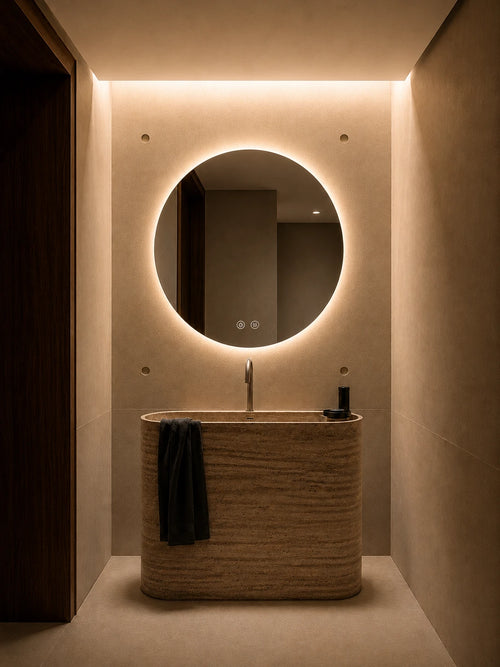
Oblio has a smallest listed variant at ₹6,999, also checked on 7 September 2026. Its description mentions a pill-shaped form, backlighting, three light colours, a defogger and touch control. Confirm the installed dimensions and orientation before ordering because the variant wording should not substitute for a clear size drawing.
These examples are not a ranking, and equal prices do not mean identical products. Feature additions may not be reflected in the variant base price. Request a confirmed total for your selected mirror rather than treating every function mentioned across the range as part of every order.
Dimming and colour adjustment solve different problems
Dimming changes brightness. It can help a mirror feel less intense during a quiet evening routine and more useful when you need visibility, within the range the product supports. Colour adjustment changes the tone of the light. A warmer setting and a whiter setting create different impressions even at similar brightness.
Do not assume that colour adjustment includes dimming. A mirror can offer several light colours at a fixed output, or brightness adjustment within a single colour. Confirm both separately if you want both. This small distinction prevents a common mismatch between expectations and the controls that arrive.
For someone who prepares for work before sunrise, adjustment may be valuable because the mirror is used without daylight. For someone whose bathroom is consistently bright and who prefers a fixed setting, simple operation may be enough. Choose a useful range of behaviours rather than collecting options without a reason.
Treat memory as a specific behaviour
Memory can reduce repeated adjustment by recalling a previous setting, but the conditions under which it works need clarification. A mirror may behave one way when switched off at its touch control and another way after the wall switch interrupts power. Ask which settings are remembered and after which type of shutdown.
Avelis explicitly mentions memory in its description. That makes it a relevant option for buyers who care about this convenience, while leaving the exact operating behaviour to be confirmed. It does not establish that memory is present in every Artessa touch mirror.
In a shared bathroom, remembered settings can be either useful or less important depending on how differently people use the light. If everyone prefers the same setting, memory saves a step. If preferences vary, easy adjustment may matter more. Think through the actual sequence rather than assuming memory automatically improves every situation.
Position the controls where they can be reached
Measure reach as well as wall space. A deep basin or countertop can make a sensor near the middle of a large mirror awkward to touch. A person should be able to use the control from a comfortable standing or seated position without stretching across fittings.
Ask where the sensor sits on the selected size and whether its location changes with orientation. A control position shown on one product image may not answer those questions for every variant. This is especially important when the mirror is intended for a user with a specific reach requirement.
Also ask whether the control symbol remains illuminated when the main light is off. In a bathroom that opens directly into a bedroom, a small indicator may matter to someone who prefers darkness. Do not assume the symbol can be disabled unless that option is confirmed.
Think about cleaning and everyday interaction
A touch area is part of a surface that will be cleaned regularly. Follow the supplied care instructions and ask how to avoid accidental activation during cleaning. Use the recommended method for the complete mirror, including its edges and electrical elements, rather than applying an aggressive cleaner because the front looks like ordinary glass.
Consider the experience for guests too. Several similar symbols can be confusing if their functions are not obvious. A brief explanation during installation is useful for a family bathroom, while a guest space benefits from controls that require little learning. More functions are worthwhile only when they remain easy to use.
Touch control does not remove the need for appropriate electrical installation. Have a qualified professional assess the supply, location and product requirements. Confirm how the mirror is isolated for servicing and how it can be removed without damaging surrounding finishes. These practical details belong in the purchase plan alongside the visible interface.
Compare the final configuration on one page
For each shortlisted mirror, record the dimensions, lighting direction, touch functions, defogger inclusion and confirmed price. Add any unanswered control questions beside the relevant model. This creates a meaningful comparison between products instead of a contest between labels such as “smart,” “premium” and “advanced.”
Choose GlowZen as a starting point for a geometric backlit design with documented touch dimming, or explore Avelis if an organic silhouette and listed memory function suit your brief. The right touch mirror makes the actions you repeat every day feel simple.
Mirrors mentioned in this guide
-

Oblio, Rounded touch-sensor LED mirror -

GlowZen, Backlit LED mirror -

Avelis, Oval LED mirror -

Kairo, LED bathroom mirror
Browse the full range: Vanity Essentials · Studio Essentials · Trade & bulk orders.