Wavy Full-Length Mirrors: A Buyer’s Guide to Quality and Price

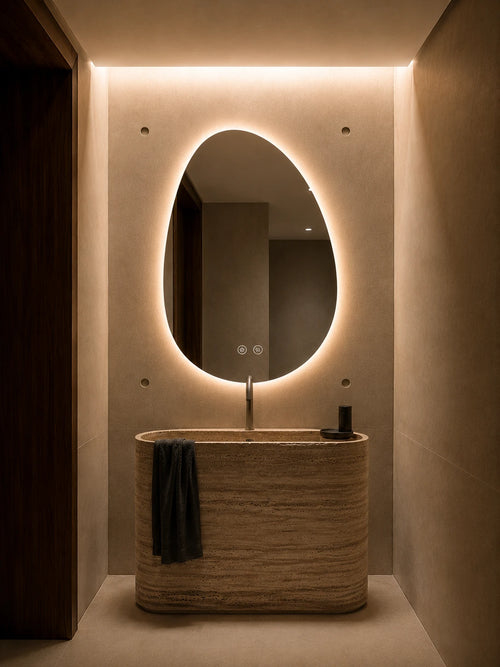
Rad turns the mirror's outline into part of the room's design. Its wavy direction brings movement to a dressing corner, even when the surrounding palette is restrained. That visual appeal is the beginning of the purchase, though. To choose well, look beyond the silhouette and understand the usable reflection, the frame, the finishing and the setup you will receive.
A wavy full-length mirror can be both useful and expressive. The aim is to find a design whose curves suit the room without frustrating the daily dressing routine. This guide uses current Artessa price examples alongside practical assessment questions. It does not claim independent testing, rank manufacturing quality or infer construction details from photographs.
Separate the outline from the reflection
“Wavy” usually describes the perimeter in this shopping context. It should not be taken to mean that the reflective surface is intended to distort your image. An expressive outline and a useful dressing reflection are separate characteristics. Ask the seller to clarify the design if the product imagery does not make that distinction clear.
When you can inspect a mirror, view the reflection from the intended dressing position and at more than one point across the surface. If you notice an issue, ask for it to be assessed rather than assuming every irregularity is part of the style. A decorative shape should be a deliberate visual choice, not an explanation for an unexpected reflection.
For an online purchase, request a straightforward video or photograph that shows the mirror in ordinary use. Highly styled images are valuable for understanding atmosphere but less useful for evaluating the reflective experience. A simple front-facing view and a close-up of the edge help answer different questions, so look for both.
Find the useful width
The maximum outside width of a wavy mirror may occur only at its broadest curves. Narrower sections can have less reflective area, and the frame may occupy part of that outline. Ask what the listed dimensions measure and, if needed, request the reflective opening at its narrower points.
This distinction matters for a dressing mirror. A person choosing purely by the widest listed measurement may receive a shape that feels more restricted than expected in use. That does not make the design unsuccessful; it means the silhouette needs to be considered alongside the task. Compare it from the position where you will actually stand.
In a compact bedroom, tape out the outer shape and mark the expected clear space in front. Open the wardrobe and check that you can step into the viewing position easily. If the mirror becomes an obstacle between the bed and storage, a more suitable placement or proportion is worth considering before ordering a larger version.
What current Rad prices tell you
Rad lists 120H x 60W cm at ₹12,999, 140H x 60W cm at ₹14,999 and 160H x 60W cm at ₹17,999. The 170H x 80W cm variant is ₹20,999. Prices were checked on 7 September 2026 and should be confirmed again for the selected order.
The first three listed sizes retain a 60 cm width while increasing height. The largest option changes both dimensions. That makes the final step a different spatial proposition, not simply ten extra centimetres of height. It deserves a fresh wall measurement, particularly if your initial plan was based on one of the narrower versions.
For a quiet dressing corner, the 160H x 60W cm variant may belong on the shortlist if that footprint fits. For a broad wall where the mirror should have greater presence, the 170H x 80W cm variant may be worth considering. Neither is universally the better buy; the useful choice depends on the room and confirmed viewing area.
Use another design to test your priorities
Brio offers listed variants including 150Hx60W cm at ₹17,499, 160Hx65W cm at ₹20,499 and 170Hx70W cm at ₹22,999, checked on 7 September 2026. Compare its current product imagery and confirmed construction with Rad when assessing which expressive outline you prefer.
At a similar height, the listed widths and prices are different. Brio's 170Hx70W cm variant costs ₹2,000 more than Rad's 170H x 80W cm variant. This does not prove a material or quality advantage. It gives you a specific comparison to investigate: the silhouette, frame, usable opening and supplied setup for each option.
You may discover that a subtler outline suits your existing furniture, or that a stronger wave is precisely what the room needs. It is sensible to pay for a design you prefer when the practical details also work. It is less sensible to assume that the more expensive option will necessarily solve the room better.
Judge the edge and frame as part of the design
Curves draw attention to the perimeter. Look at how the shape flows, whether the finish appears consistent and how the front meets the side profile. Request close photographs of tight curves and transitions. These areas help you understand the visual execution beyond the broad impression of a lifestyle image.
If the frame material matters to your purchase, obtain a precise description. Do not infer solid timber, a particular coating or glass thickness from the price. Ask about the backing and mounting arrangement as well, because the rear construction is part of the finished product even when it is not visible in the styled room.
Finish maintenance should also be clear. A deeply shaped frame may have recesses that need more careful dusting than a plain profile. Follow the maker's care instructions for the actual materials, and avoid assuming that a cleaner suitable for the glass is also suitable for the frame. The practical question is whether you are comfortable caring for the form you choose.
Give the waves room to work
A wavy mirror often looks strongest with some clear wall around it. Crowding it between several small decorative objects can make the perimeter harder to read. In a restrained bedroom, let the silhouette carry the visual interest and choose nearby furniture that does not compete with every curve.
You do not need to repeat the wave throughout the room. A shared colour or a related material can connect the mirror to the interior more quietly. Conversely, if you enjoy an expressive room, establish a deliberate relationship between the mirror and other curved pieces instead of adding shapes without considering their relative scale.
Finally, confirm the supported installation method. A leaning photograph does not establish that a stand is included or that the mirror can remain unsecured. Ask about compatibility, restraints and the installed footprint for your selected variant. Explore Artessa's Studio Essentials with these details in mind, and choose a wavy full-length mirror whose character and everyday usefulness belong together.
Mirrors mentioned in this guide


Browse the full range: Vanity Essentials · Studio Essentials · Trade & bulk orders.